What will it take to accelerate the use—and application—of AI in the OR?
It starts with technology, clinical domain expertise, sound economics and an evolution in regulation and certification. And if done right, there’s potential for an exponential increase in better patient outcomes.
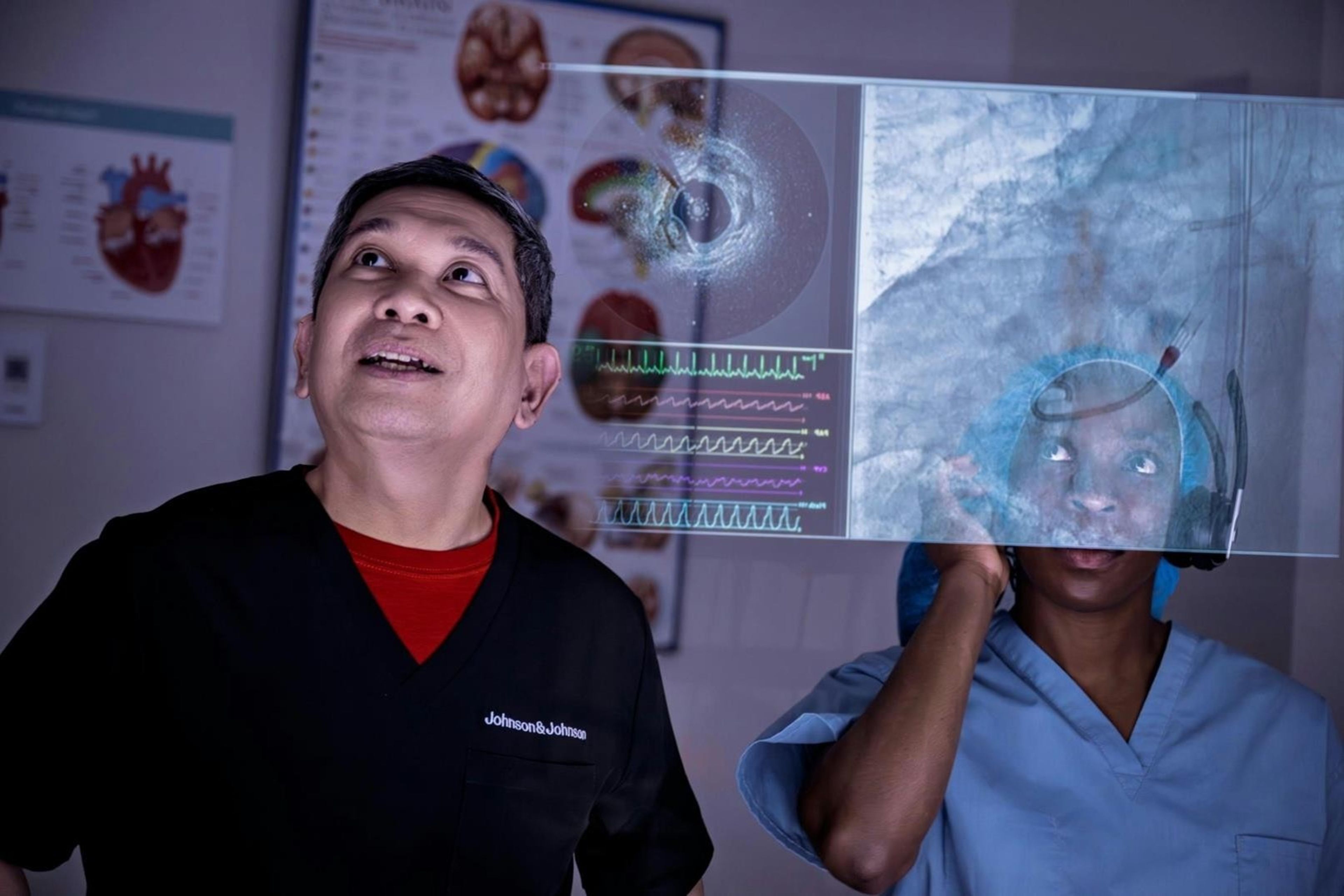
What began in 1971 with the first artificial medical consultant1 that could diagnose a patient has evolved into a powerful ally for clinicians: Artificial intelligence (AI) has been helping fuel healthcare advances like early cancer detection, real‑time symptom tracking via vital sign analysis2 for people living with chronic conditions and enabling personalized patient treatment plans—just to name a few.
In surgery, AI and machine learning (ML) are used within devices and robotics to, for example, identify major anatomical structures3 and go zones (areas in which surgeons can safely operate) and no-go zones (dangerous areas for dissection),4 as well as for clinical guidance in the form of decision support for complex procedures and recommended next best actions.5 AI is also used post-operatively to improve performance, education and training for surgeons, and to identify procedure duration.6
But to address healthcare's most pressing surgical challenges—from administrative burden that leads to burnout to developing faster, more accurate ways of diagnosing and treating patients—experts agree: The ease and use of this technology needs to scale.
It's a truth Frank Lee, M.D., knows well. A general surgery resident at Mayo Clinic in Rochester, Minnesota—and part of the team of award recipients of the first cohort of the Polyphonic™ AI Fund for Surgery, an initiative launched by Johnson & Johnson to drive innovation in the AI space—Lee was recently joined by his advisors, Cornelius A. Thiels, D.O., M.B.A., a surgical oncologist at Mayo Clinic, and Hojjat Salehinejad, Ph.D., an AI staff scientist and expert in computer vision, to discuss their innovation, an AI pipeline for post-operative wound monitoring.
“With the advent of digital health technology, our role as clinicians is moving from within the hospital walls and clinic walls into patients’ homes,” Dr. Lee explained. “More and more patients are sending in messages through the portal with photos of their wounds.”
Dr. Lee noted that this can create administrative burden for staff. “So, we asked ourselves: Is there a way to do this better?” Their solution: an AI “triage” tool that uses analytics to review patient-submitted postoperation wound images to detect complications earlier.
QAS.AI, another Polyphonic AI Fund for Surgery award recipient, presented its AI-powered tool that analyzes vascular imaging data to support real-time decision-making during and after surgical procedures.
“We want to develop responsible data-driven surgical AI tools, and we are very excited to have the opportunity to join a global ecosystem that unites clinicians and engineers,” said Ciprian Ionita, a medical imaging scientist and CSO and co-founder of QAS.AI.
Indeed, the future of AI in surgery is bright. Below, Shan Jegatheeswaran, Global President, Polyphonic, Johnson & Johnson MedTech, discusses its potential, and how Johnson & Johnson MedTech is driving innovation within the field through efforts like the Polyphonic AI Fund for Surgery.
Q: What potential does AI hold for surgery?
Shan Jegatheeswaran: AI and ML models—or advanced analytics in general—are not new to surgery or the operating room (OR). What I believe we are on the cusp of is the productization and scaling of intelligent learning models embedded within surgical workflows at scale. Today, some of the best “math” is locked within a document and not widely available for practical use.
What we’d like to see is the acceleration of AI in ORs globally. That will require technology, clinical domain expertise, sound economics and an evolution in regulation and certification. But if (or when) it happens, there’s a potential for an exponential increase in better patient outcomes.
Today's ORs predominantly rely on the expertise of the individual surgeon and the ability of their medical teams to complete a procedure. With AI, there is potential to provide additional support to these care teams enabling surgeons to tap into the collective wisdom of all procedures ever done for any given type of patient or procedure.
Once this happens, every next procedure can be better than the previous ones. Empowered with this data, surgical teams can access best practices, reduce variability and improve safety for patients. Imagine the impact this could have on surgeons working in areas with limited resources.
Q: What actions need to be taken to start using AI in surgery at scale?
SJ: Surgeons often tell us, ‘Don't go after the most complex and complicated use case when it comes to developing AI in medical technology.’ They want us to help make their procedures more efficient and augment their skill sets.
We don’t want to jump to the end state immediately, even if the technology allows it. What we want to do is manage it and bring along our user base by automating activities like pre- and post-procedure documentation, collaboration and training. Those are burdens you can alleviate for surgeons.
Q: How does the concept of ‘zero harm’ drive innovation with AI and surgery?
SJ: Anything we can do to improve skill or judgment puts the surgeon and their team in a better place to be able to do zero harm. How do you augment the surgical experience while the team is in surgery so that they can get alarms to avoid critical structures and receive clinical guidance and suggestions?
One opportunity for AI during a procedure is to help with the identification and delineation of anatomical structures, like the main arteries or organs. Just as everyone's unique on the outside of the body, everyone's unique on the inside. Patient by patient, the surgeon needs to be able to understand what to do and what not to do, and models and algorithms can help them with that.
Post-surgery, there are huge opportunities for data analysis to improve performance. Having algorithms analyze video and other data from surgeries can allow surgeons to calibrate hand gestures and other movements during procedures in a very finite way. Those are all things that don’t happen today because you don’t have a way to capture and analyze that amount of data. But with AI, that’s just going to be how surgery is done in the future.
Conceptually, we ask ourselves: Why can’t we bring together the innovation we have seen in the automative, aviation and sports industries to surgeons, their teams and patients? The answer is we can, should and will.
Q: How is industry working to quell the fears or concerns of those who are wary about AI in surgery?
SJ: The trust factor is a big deal. So is consistency. You need the output of any given model to be consistently correct, because surgery can have materially adverse consequences. Change management will also be a huge factor. AI in surgery will involve IT, data privacy, compliance and legal teams, as well as Csuite strategic discussions and more. All of these are opportunities and challenges for getting more AI into the OR.
Distribution can also be difficult. The health data needed for AI medical technology involves heavily regulated data sets. This all makes training algorithmic models difficult.
Gaining trust starts with smart people collaborating with each other and building on each other's thoughts. Industry plays a large role in supporting that through content and participation. The second key area is investment and engagement, like what we’re doing with the Polyphonic AI Fund for Surgery.
Q: How will AI help level the playing field around the globe with variability of experience between different surgeons?
SJ: The two themes that you always hear about in surgery are equity and access. Today, 5 billion patients don't have access to safe surgery.7 And from an equity perspective, 25% of procedures end up with complications annually.8 So how do we minimize that or bring it down to zero?
From an equity perspective, with software, you can put best practices and intelligence into the hands of people across the world who otherwise wouldn't have been able to access it. If you're looking at a situation only five times a year, it’s very difficult to have a best-practice outcome. But with applications or expert remote collaboration at the time of procedure, you are able to access the best advice for any given situation.
From an access perspective, digital and software are, by design, highly distributable, and the cost of entry is much lower through software applications.
Q: One of the biggest drivers of surgeon burnout is the administrative stuff that comes along with surgery. How do you think AI can help?
SJ: We talk a lot about surgical video, but other important data comes from the conversations that happen during the procedure, as well as from the movement of people throughout the space and how the procedure is set up. Different parts of the world have different procedural setups.
With ambient data sets, we can personalize room setup to minimize inefficiencies so that surgeons aren’t rearranging things with the patient in the room.
Q: How is the Polyphonic AI Fund for Surgery advancing innovation with AI and surgery?
SJ: The Polyphonic AI Fund was born from the understanding that we need to build a community of smart individuals working on complex AI problems. Whether they’re working on problems related to the model itself, data management or the regulatory element, our goal is to scale AI so we can get it into the OR.
One of the initial initiatives of the Polyphonic AI Fund will be to leverage the QuickFire Challenge program, which provides a unique opportunity for innovators to submit their AI innovations for the chance to receive no-strings-attached funding, mentorship and resources to help develop their technology. We kept the application criteria very open to attract many different types of AI innovations, and we were very surprised by the engagement.
This challenge received a notable number of applications, demonstrating the excitement among entrepreneurs, academics and beyond to innovate and collaborate within this space. About half of our applicants for the first cohort were from outside the U.S., many from academic medical institutions and startups.
The depth and the quality of the work happening is impressive. And it underscores the importance of the role Johnson & Johnson MedTech can play, which is bringing some discipline to how models are designed, built, certified and governed.
References
- Hirani, R., Noruzi, K., Khuram, H., Hussaini, A. S., Aifuwa, E. I., Ely, K. E., Lewis, J. M., Gabr, A. E., Smiley, A., Tiwari, R. K., & Etienne, M. (2024). Artificial Intelligence and Healthcare: A Journey through History, Present Innovations, and Future Possibilities. Life (Basel, Switzerland), 14(5), 557.
- Maleki Varnosfaderani, S., & Forouzanfar, M. (2024). The Role of AI in Hospitals and Clinics: Transforming Healthcare in the 21st Century. Bioengineering (Basel, Switzerland), 11(4), 337
- Birkhoff, D. C., van Dalen, A. S. H. M., & Schijven, M. P. (2021). A Review on the Current Applications of Artificial Intelligence in the Operating Room. Surgical innovation, 28(5), 611–619.
- Madani, A., Namazi, B., Altieri, M. S., Hashimoto, D. A., Rivera, A. M., Pucher, P. H., Navarrete-Welton, A., Sankaranarayanan, G., Brunt, L. M., Okrainec, A., & Alseidi, A. (2022). Artificial Intelligence for Intraoperative Guidance: Using Semantic Segmentation to Identify Surgical Anatomy During Laparoscopic Cholecystectomy. Annals of surgery, 276(2), 363–369.
- Navarrete-Welton, A. J., & Hashimoto, D. A. (2020). Current applications of artificial intelligence for intraoperative decision support in surgery. Frontiers of medicine, 14(4), 369–381.
- Birkhoff, D. C., van Dalen, A. S. H. M., & Schijven, M. P. (2021). A Review on the Current Applications of Artificial Intelligence in the Operating Room. Surgical innovation, 28(5), 611–619.
- Maswime, S., Jayaraman, S., Alaba, O., & Robalo, M. (2025). Universal access to surgical care-A global public health priority. PLOS global public health, 5(4), e0004326.
- Why safe surgery is important. World Health Organization (WHO).
US_SRG_RADS_411823.1